
The Justice Court and Municipal Court Share a Building, Not a Docket
Lafayette Justice Court and Oxford Municipal Court share the F.D. Buddy East Parkway complex, yet each clerk keeps a separate docket. Check which agency wrote the ticket before you pick a counter. Sheriff, University Police, and Highway Patrol matters generally land in Justice Court. Oxford Police citations start with Municipal Court instead.
Federal Warrants Follow the Northern District Route
The federal courthouse and the U.S. Marshals office sit in Oxford, but their process stays outside the Lafayette County system. For an unsealed federal matter, start with the Northern District clerk and PACER. Sealed documents and investigative records remain closed to ordinary public access.
How to Check for a Warrant in Lafayette County
Lafayette County publishes no official list of active warrants by name, so the first move is matching the office to the event. Sheriff, University Police, or Mississippi Highway Patrol traffic matters belong to Justice Court. Oxford Police citations go to Oxford Municipal Court, and Circuit or County Court dockets sit with the Circuit Clerk. Walking in cold wastes a trip. Bring the full legal name, date of birth, citation or case number, issuing agency, and the approximate date of the event, since clerks work faster with specifics. Ask each office exactly what it can confirm over the phone or counter and what written proof it will hand over afterward. A lawyer can also make a status inquiry quietly and plan a response, because an unofficial search result is never the last word on whether a warrant stands. The clerk of the issuing court is the one voice that matters.
- Identify the officer or agency shown on the citation, release paper, or notice.
- Contact the corresponding clerk and supply the case identifiers, not a broad list of private personal data.
- Check municipal court separately when a city police department initiated the case.
- Use the county public-record request route for an existing public document, policy, log, or aggregate record.
- If process is confirmed, consult counsel about appearance, bond, surrender, or a motion before acting.
No Single Lafayette Search Covers Every Court
The Lafayette County Sheriff page lists law-enforcement contacts but offers no public warrant lookup. Mississippi's Criminal Information Center serves police agencies, not a statewide name query for the public. So the court matters more than a generic search: a municipal citation, a county misdemeanor, a felony docket, a chancery case, and a federal case each sit with a different clerk.
Types of Warrants in Lafayette County
What separates warrant types in Lafayette County is who issued the paper and what event triggered it. Mississippi procedure draws its lines clearly. A probable-cause arrest warrant is one thing. A bench order entered in an existing case is another, and a search warrant authorizing police to search a described place or item is a third.
| Warrant Type | How It Arises | Who Issues It |
|---|---|---|
| Arrest warrant | Probable cause supports taking a named person into custody | Judge with jurisdiction |
| Bench warrant | Missed appearance or unmet court obligation | Judge in the existing case |
| Search warrant | Probable cause supports a defined search | Authorized judge |
| Capias / failure-to-appear | Process follows a missed setting or court directive | Issuing trial or municipal court |
Agency on the Citation Determines the First Clerk
Traffic routing matters more in Lafayette County than most places. A citation from the Sheriff, University Police, or Highway Patrol goes to Justice Court at 72 F.D. Buddy East Parkway. An Oxford Police ticket belongs with Oxford Municipal Court, Suite 200, in the same complex. Sharing a building does not make the two dockets interchangeable.
What a Lafayette County Warrant Record Shows
A Lafayette County docket entry tied to a warrant may list a case identifier, the subject's name, the alleged charge, the issuing court, a filing event, and status language. MEC labels like "Bench Warrant Issued," "Bench Warrant Returned," or "Capias Pending" are events, not verdicts. A clerk should interpret them rather than a reader guessing from the label alone.
| Warrant Number | The court or agency identifier used to request the matching document. |
|---|---|
| Subject Name | The name on the process; use a second identifier to avoid a mistaken match. |
| Charge / Offense | The alleged offense or underlying court obligation, not a finding of guilt. |
| Issuing Court | The office with authority to explain or recall the process. |
| Bond Amount | An amount if set; availability and conditions require current confirmation. |
| Status | Current terms may include issued, returned, served, recalled, or pending. |
MEC Docket Language Needs Context
The Third Circuit MEC site can surface public docket information for Circuit and County Court matters anywhere in Lafayette County, but a docket event is not a live warrant certification. "Returned," for example, may just describe a filed return rather than the outcome a reader assumes. Call the Circuit Clerk at (662) 234-4951. Ask which public event is current and whether another court controls the matter.
Who Issues and Serves Lafayette County Warrants
Judges issue warrants within their own jurisdiction. The Lafayette County Sheriff serves county process and runs the Detention Center, while Oxford Police and town officers handle their local duties. Serving and record-keeping can fall to different offices, so the agency that served a warrant cannot always change the issuing court's order.
Lafayette County Sheriff and Detention Center
711 Jackson Avenue East
Oxford, MS 38655
(662) 234-6421
Public Requests Are Narrower Than Warrant Checks
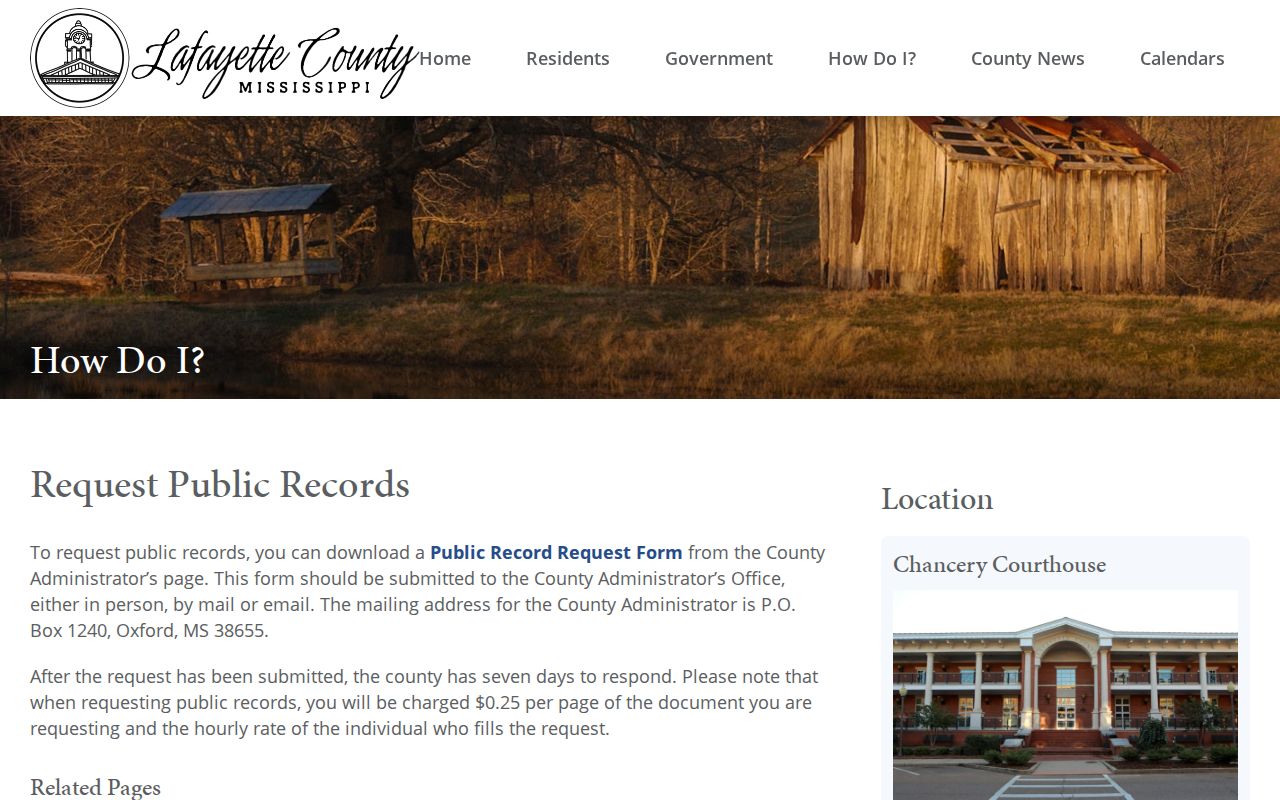
Lafayette County takes public-record requests in person, by mail, or by email through its published administrative route. The county posts a seven-day response framework plus charges of $0.25 per page and applicable staff time. A request works best when it names one custodian, a record category, a date range, and an electronic format; it cannot ask the county to build a screening list on a private person. That route covers existing records, and the county's records policy page spells out the request steps.
What to Do If You Have a Lafayette County Warrant
Verify the issuing court and its current status first. From there, counsel can weigh a scheduled appearance, voluntary surrender, bond, payment or compliance with the underlying obligation, or a motion asking the judge to recall or quash the warrant. Paying alone does not clear a Lafayette County docket until the court confirms the change.
Important: Speak with a lawyer before surrendering or visiting an agency; any law-enforcement contact can result in arrest on confirmed active process.
Oxford, Abbeville, and Taylor Use Separate Local Routes
Oxford posts a municipal-court contact and a citation-payment link, though the payment screen is no substitute for a warrant search. Abbeville lists Town Hall and court-clerk contacts with no lookup tool. Taylor schedules its municipal docket at Town Hall on the first Thursday at 7 p.m., but that calendar is not an invitation to show up unannounced and settle a Lafayette County warrant.
Public Access to Lafayette County Warrant Records
The Mississippi Public Records Act opens qualifying government records in Lafayette County, subject to exemptions and the separate rules governing judicial records. Sealed material, juvenile information, confidential investigative files, and unserved process may be withheld or redacted. Requesting a public docket entry is one thing; demanding operational law-enforcement data is another.
Key Rules:
County public-record information explains the local submission and fee route.
Ask for segregable public portions when a record also contains exempt information.
Use the relevant clerk for court dockets; the County Administrator does not hold every municipal, state, or federal record.
Warrant Records by City in Lafayette County
Oxford, Abbeville, and Taylor are Lafayette County's three incorporated cities. Each municipal court takes ordinance, traffic, and appearance cases. County-agency citations go through Justice Court instead. Every city profile lists the local contact that each office publishes and flags the steps it leaves unlisted.
Oxford Warrant Records
26,430 · Oxford Police matters route first to Oxford Municipal Court.
Abbeville Warrant Records
372 · Town Hall and the town/court clerk are the published contacts.
Taylor Warrant Records
355 · Town Hall publishes a monthly municipal-court schedule.